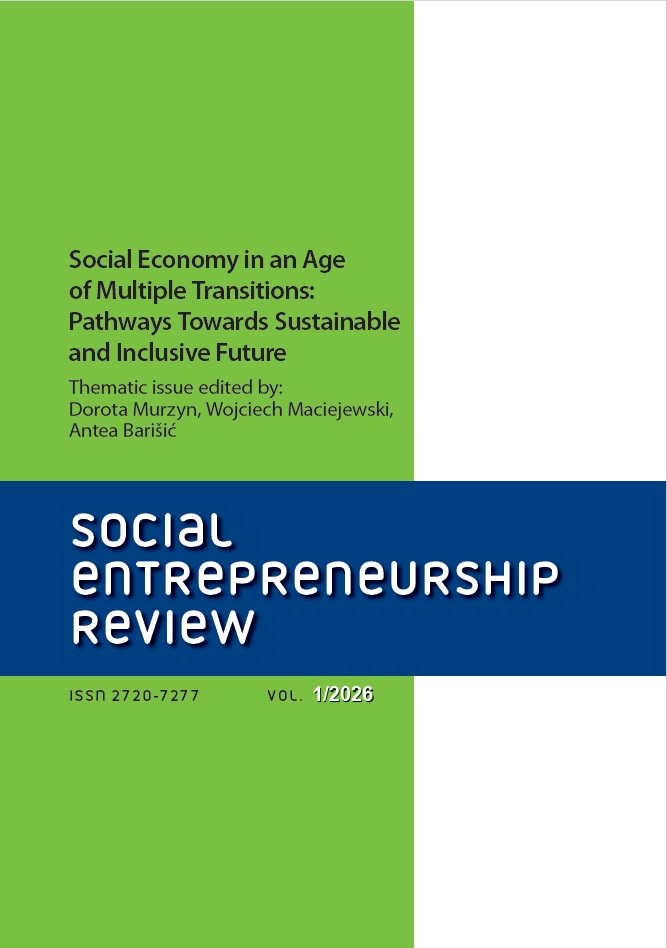
Call for Papers: Social Economy in the Era of Polycrisis: Institutions, Digital Transformation and Just Transitions

2026-07-20

The contemporary world facing a convergence of ecological, social, economic and technological challenges call for new ways of thinking about development, governance and collective action. The Social Economy and Social and Solidarity Economy (SSE) are increasingly recognized not as peripheral alternatives, but as essential components of resilient and democratic socio-economic systems.

SEE organizations should not be understood primarily as providers of social services. Rather, they are institutions of discovery, coordination and adaptation. Operating under conditions of uncertainty, they identify unmet social needs, mobilize dispersed knowledge embedded within communities, coordinate collective action among diverse stakeholders, and continuously adapt to changing social, economic and technological environments. From this perspective, SEE organizations perform entrepreneurial and institutional functions that extend far beyond service delivery. They create new forms of cooperation, experiment with innovative governance arrangements, strengthen social capital, and generate institutional complementarities that enhance the resilience of local and regional ecosystems. Their comparative advantage lies not only in addressing market and government failures, but also in discovering opportunities for collective problem-solving that neither markets nor hierarchical public institutions can easily identify or coordinate.

Drawing inspiration from the intellectual legacy of Elinor Ostrom Vincent Ostrom, Paul Dragos Aligica, Peter J. Boettke, Friedrich Hayek, Daron Acemoglu, James Robinson, Avner Greif, Douglass North and many other scholars of institutional economics and robust political economy, this special issue seeks contributions that explore how social economy organizations contribute to addressing the limits of top-down governance, overcoming the "pretence of knowledge", strengthening institutional complementarities, and revitalizing communities through bottom-up cooperation and collective entrepreneurship.

At the same time, digital transformation is reshaping the landscape in which cooperatives, social enterprises, mutuals, foundations, and other social economy organizations operate. Digital technologies create unprecedented opportunities for visibility, networking, e-commerce, organizational learning and social innovation. However, they also generate new challenges related to cybersecurity, financial sustainability, digital exclusion, organizational capabilities and the costs of technological adaptation.

We therefore invite theoretical, empirical and comparative papers examining, among others:

  • the role of social economy organizations in building resilient institutional ecosystems;
  • governance, institutional diversity and community self-organization;
  • digital transformation of social enterprises and cooperatives;
  • artificial intelligence, digital platforms and the future of democratic entrepreneurship;
  • social media, digital communication and community engagement;
  • organizational innovation and new models of cooperation;
  • public policies supporting Social and Solidarity Economy ecosystems;
  • territorial development, local resilience and community revival;
  • ecological and digital transitions through the lens of social economy;
  • economic democracy, participation and inclusive governance;
  • institutional conditions for sustainable and scalable social entrepreneurship.

We particularly welcome studies that combine institutional analysis with practical implications and provide evidence from diverse national and regional contexts. Comparative research, interdisciplinary approaches and case studies illustrating successful ecosystem-building initiatives are especially encouraged.

The guiding premise of this thematic issue is that ecosocial and digital transitions cannot be understood merely as technological processes. They are fundamentally political, organizational and cultural transformations that raise crucial questions about governance, ownership, participation and the distribution of economic power.

SEE organizations offer more than alternative business models - they embody an alternative understanding of the economy itself, grounded in cooperation, reciprocity, democratic governance and the centrality of human and community well-being. Their capacity to contribute to just transitions depends not only on their internal strengths but also on the quality of the institutional ecosystems in which they operate, including supportive public policies, research networks, educational institutions and collaborative partnerships.

We also invite contributions reflecting on the role of universities and researchers as active participants in these transitions. Rather than remaining external observers, academic communities increasingly co-create knowledge together with practitioners, public administrations and civil society organizations. Understanding how such collaborative knowledge ecosystems emerge and contribute to sustainable development represents another important dimension of this special issue.

By bringing together perspectives from institutional economics, social entrepreneurship, governance studies, sustainability transitions, digital transformation and public policy, this special issue aims to advance scholarly understanding of how Social Economy can contribute to addressing the twenty-first century polycrisis while strengthening democratic, inclusive and sustainable development.

We warmly invite researchers from around the world to contribute to this interdisciplinary discussion and to help shape the future research agenda on Social Economy, institutional resilience and just digital and ecological transitions.

Editors:

Millan Diaz-Foncea (University of Zaragoza), Özgür Burçak Gürsoy (Beykoz University), Alejandra Millán (Universitat Politècnica de València), Renata Śliwa (University of the National Education Commission, Krakow)  


Literature:

Acemoglu D., Robinson J. (2023). Weak, Despotic or Inclusive? How State Type Emerges from State versus Civil Society Competition. American Political Science Review, 117(2).

Aligica, P. D. (2018). Public entrepreneurship, citizenship, and self-governance. Cambridge University Press.

Aligica, P. D., & Boettke, P. (2011). Institutional design and ideas-driven social change: notes from an ostromian perspective. The Good Society, , 20(1), 50-66.

Bouchard, M. J., & Rousselière, D. (Eds.). (2026). A modern guide to the social and solidarity economy. Edward Elgar Publishing.

Calvo, S., Morales, A., & Zikidis, Y. (2017). Social and solidarity economy: The world’s economy with a social face. Routledge.

Granovetter, M. (1985). Economic action and social structure: The problem of embeddedness. American Journal of Sociology, 91(3), 481-510.

Hayek F. A. (2020). Prawo, legislacja i wolność. Aletheia.

Kostilainen, H., & Karjalainen, J. (2025). Institutional and territorial drivers of rural social enterprise ecosystems: Evidence from Finland. Social Entrepreneurship Review, 2, 137–151. https://doi.org/10.15678/SER.2025.2.09.

OECD, European Union. (2025). Social economy in Europe: Contributing to competitiveness and prosperity. OECD Publishing. 

Ostrom, E. (1998). A behavioral approach to the rational choice theory of collective action: Presidential address, American Political Science Association, 1997. American political science review, 92(1), 1-22.

Ostrom, V. (2008). The intellectual crisis in American public administration. University of Alabama Press.

Pacut, A., & Laurisz, N. (2025). Enhancing social innovation in public sector policy to address grand challenges. In Handbook on post-Schumpeterian innovations (pp. 286-302). Edward Elgar Publishing.

Yi, I. (Ed.). (2023). Encyclopedia of the social and solidarity economy: A collective work of the United Nations Inter-Agency Task Force on SSE (UNTFSSE). Edward Elgar Publishing.

Żabiński, M. (2018). Role of social economy in process of implementing the neo-weberian model of the state. Social Entrepreneurship Review, 2, 67-73.


SUBMISSION

The complete articles must be formatted according to Social Entrepreneurship Review requirements (link) and submitted until September 20, 2026 via the OJS system at https://ser.uek.krakow.pl/index.php/


Please choose Section Cfp for this call.

Scheduled: Vol. 2/2026


For further information, please contact the guest editors:

Primary contact:
Renata Śliwa (University of the National Education Commission, Krakow), renata.sliwa@uken.krakow.pl 

Millan Diaz-Foncea (University of Zaragoza), millan@unizar.es

Özgür Burçak Gürsoy (Beykoz University), burcakgursoy@beykoz.edu.tr

Millán Franco, María Alejandra (Universitat Politècnica de València), mamilfra@upv.es