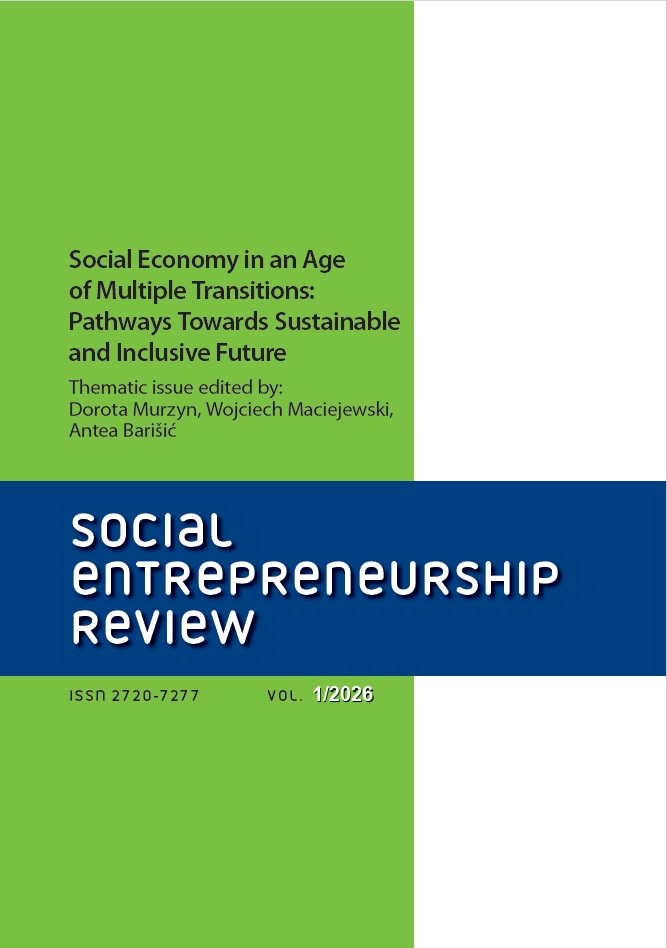
CfP: Social Economy and the Green Transition: Pathways Towards Sustainable and Inclusive Future

2025-11-26

The role of social economy in supporting inclusive and just green transition towards a climate-neutral economy, with ecological, social and economic benefits, has been increasingly recognized in both scientific research (e.g. Ziegler et al., 2023; Hillman, Axon & Morrisey, 2018) and more recently in policy discussions and recommendations (Council of the EU, 2023; OECD, 2023).

Social economy entities have the capacity to shape our future and to drive a greener and more inclusive transformation, as they employ a wide range of interdisciplinary and sustainable approaches and tools tailored to the needs of local communities (European Commission, 2021). Practices and business models developed within the social economy make these organizations particularly well suited to fostering local and collective initiatives that generate both environmental and social benefits. Accordingly, sustainability has become a central theme in social enterprise research, encompassing diverse perspectives on sustainable social impact (Salustri et al., 2025), sustainable social innovation (Sampaio & Sebastião, 2024), and sustainable business models (Wagner & Kabalska, 2025). The social economy’s contribution is especially significant in advancing the circular economy (Ziegler et al. 2023; Villalba-Eguiluz et al., 2023). Through their participatory and value-driven character, social economy entities are able to integrate environmental, economic, and social goals, offering concrete responses to global challenges such as climate change, energy transition, or socio-economic exclusion.

At the same time, the green transformation requires new competences, governance models, and cross-sectoral cooperation (Pedersen et al., 2021). It calls for systemic change and the inclusion of civil society actors, academia, and business in the co-creation of sustainable solutions. In this context, social economy entities can act as key agents of change, facilitating the emergence of circular and regenerative economies, promoting eco-innovation, and supporting fair and inclusive transitions in line with the principles of sustainable development.

The aim of this special issue of Social Entrepreneurship Review is to explore the potential, role, and limitations of the social economy in the ongoing green transition. We seek to explore how social enterprises and other social economy organizations contribute to (environmental) sustainability, what challenges they face, and how their experiences can inform broader development policies.

We invite contributions from academics, practitioners, policymakers, and other stakeholders interested in the role of social economy in inclusive and just green transition. We welcome research papers, case studies, theoretical discussions, and policy analyses that focus on (but are not limited to) the following topics:

  • Social entrepreneurship in addressing the challenges of contemporary economies;
  • The role of social enterprises in the green transformation and in combating climate change;
  • Nature-Based Solutions (NBS) for fostering sustainable social innovation;
  • Education and capacity-building for professionals in the social economy and green transition;
  • Eco-citizenship and its role in responding to socio-economic and environmental challenges;
  • Determinants and pathways of sustainable economic development;
  • Socially responsible business practices in the face of climate and economic crises;
  • Policy frameworks and institutional support for integrating environmental and social objectives;
  • Case studies of green initiatives within the social economy (successes, failures and lessons learned)

We particularly encourage submissions that take a multidisciplinary approach, combine theory with practice, or present comparative and international perspectives. Papers employing qualitative, quantitative, or mixed methods are welcome.

All papers submitted will undergo a double-blind peer-review process, and accepted papers will be published in a special issue of the Social Entrepreneurship Review.

Submission Guidelines

Authors should submit original and unpublished papers that is not under consideration elsewhere.

Manuscript length should not exceed 22 standard pages (including references, tables and figures) and must be formatted following the Social Entrepreneurship Review requirements available on the journal’s website (link). They should be submitted via the journal’s online submission system https://ser.uek.krakow.pl/index.php/

Please choose Section Cfp for this call.

Submission deadline: 31.01.2026

Language of the issue: English

Scheduled: Vol. 1/2026

Keywords: social economy, green transition, sustainable development, inclusive growth


For further information, please contact the guest editors:

Dorota Murzyn, The University of the National Education Commission, Krakow, Poland, dorota.murzyn@uken.krakow.pl

Antea Barišić, University of Zagreb, Faculty of Economics and Business, Croatia, abarisic@net.efzg.hr

Wojciech Maciejewski, The University of the National Education Commission, Krakow, Poland, wojciech.maciejewski@uken.krakow.pl


Suggested readings:

Fay, M. (2012). Inclusive green growth: The pathway to sustainable development. World Bank Publications.

Hudon, M., & Huybrechts, B. (2017). From Distant Neighbours to Bedmates: Exploring the Synergies Between the Social Economy and Sustainable Development. Annals of Public and Cooperative Economics, 88(2), 141-154.

Picciotti, A. (2017). Towards Sustainability: The Innovation Paths of Social Enterprise. Annals of Public and Cooperative Economics, 88(2), 233-256.

Sołtysik, M., Wojnarowska, M., Urbaniec, M., Zabkar, V., Ćwiklicki, M., & Varese, E. (2024). Sustainable Business in the Era of Digital Transformation: Strategic and Entrepreneurial Perspectives. Routledge.

Szczygieł, E., & Śliwa, R. (2023). Social economy entities as a place to develop green skills – research findings. Social Entrepreneurship Review1, 44–56.

Vaquero García, A., Bastida, M., Vazquez Taín, M. Á., & Del Río, M. (2025). The broad spectrum of sustainability and the social economy: Perspectives from bibliometric data. Journal of the Knowledge Economy, 16(2), 10811-10840.


References:

European Commission (2021). Communication from the Commission to the European Parliament, the Council, the European Economic and Social Committee and the Committee of the Regions, Building an Economy that Works for People: an Action Plan for the Social Economy. Brussels, COM (2021) 778 final.

Hillman, J., Axon, S., & Morrissey, J. (2018). Social enterprise as a potential niche innovation breakout for low carbon transition. Energy Policy117, 445-456.

Pedersen, E. R. G., Lüdeke-Freund, F., Henriques, I., & Seitanidi, M. M. (2021). Toward collaborative cross-sector business models for sustainability. Business & Society60(5), 1039-1058.

Salustri, A., Sacchetti, S., & Antonelli, M. A. (2025). Social and solidarity economy: a conceptual framework for social impact measurement and evaluation. Public Finance Research Papers, (67).

Sampaio, C., & Sebastião, J. R. (2024). Social innovation and social entrepreneurship: uncovering themes, trends, and discourse. Administrative Sciences14(3), 53.

Villalba-Eguiluz, U., Sahakian, M., González-Jamett, C., & Etxezarreta, E. (2023). Social and solidarity economy insights for the circular economy: Limited-profit and sufficiency. Journal of Cleaner Production, 418, 138050.

Wagner, R., & Kabalska, A. (2025). Between involvement and profit: Value (un-) captured by a born-social start-up. Journal of Social Entrepreneurship16(2), 570-595.

Ziegler, R., Bauwens, T., Roy, M. J., Teasdale, S., Fourrier, A., & Raufflet, E. (2023). Embedding circularity: Theorizing the social economy, its potential, and its challenges. Ecological Economics214, 107970.

Council of the EU (2023) Council Recommendation on developing social economy framework conditions. Available at: https://data.consilium.europa.eu/doc/document/ST-13287-2023-INIT/en/pdf

OECD (2023) Regional social economy strategies: common challenges and avenues for development. Available at: https://www.oecd.org/content/dam/oecd/en/publications/reports/2023/12/regional-social-economy-strategies_558dc0a4/cef31b9c-en.pdfcak